WATERSHED DISTRICT
Middle Fork Crow River


Safe Wake Zonation
Help protect the lakes we all love for generations to come.
Did you know that wake boats can have a real impact on Minnesota's lakes if not operated properly? When operated too close to the bottom of the lake and shoreline, powerful waves from wake and surf boats can erode shorelines, stir up nutrients that fuel algal blooms, and disrupt fish habitat.
MPR's Kristi Marohn explains the newly released research from the University of Minnesota on the negative impact of wake boats on Minnesota lakes.
KARE 11's story explains the UMN's study on the power of wake boat waves and why wake boats require a greater distance from shore to reduce the potential impact of their large, powerful waves.
UMN's St. Anthony Falls Laboratory documented the impact of wake and surf boats upon the lakebed by utilizing sensors and data collection hardware. These videos show how wake boats in shallow water create a lot of turbulence and suspend bottom sediments, like sand, clay, and shells, into the water. Disruption of the lakebed creates a noticeable impact by reducing people's experience on the water and degrades the quality of the lake.
Minnesota does not currently have statewide rules governing wakesurfing. In Minnesota, wake boats are recommended to stay 200 feet away from shore. Rulemaking is left to local and county governments and conservation districts. Research from the University of Minnesota's St. Anthony Falls Laboratory shows that wakesurf boats generate the largest and most energetic waves requiring at least 500 feet from shore and 20+ feet of water to dissipate safely–far beyond Minnesota's current guideline for common recreational boats.
The Middle Fork Crow River Watershed District has provided maps of several recreational lakes with this 'Safe Wake Zonation' applied to serve as a guide as to where wake boats can operate safely. Please note: these maps are for informational purposes only. No laws or regulations are currently in place for wake restrictions. These maps were made using contours that have been digitized from existing lake contour maps. Accuracy is not guaranteed.
Safe Wake Zonation Maps
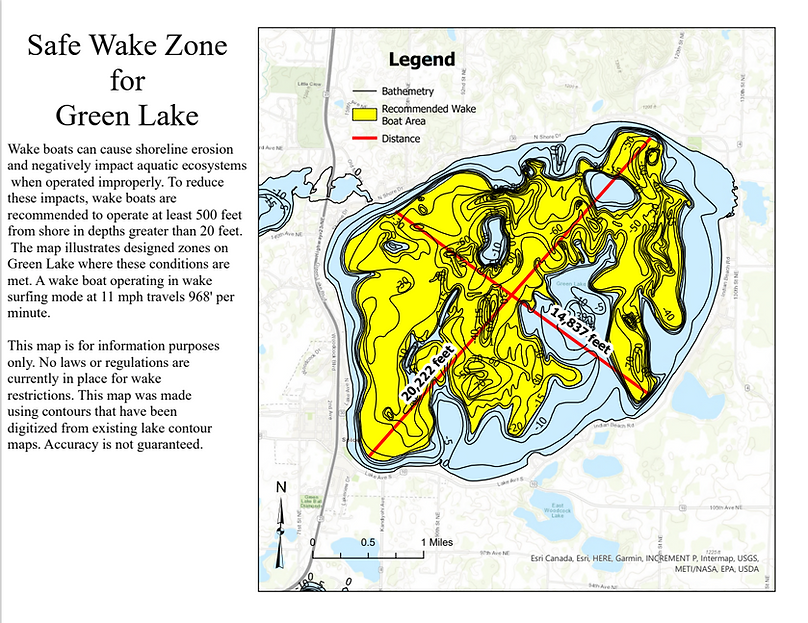
Maps of Green, Diamond, and Calhoun Lakes with the Safe Wake Zonation applied to depict the recommended 500 feet away from shore in depths of greater than 20 feet. The yellow areas illustrate designated zones where these conditions are met.
Maps can be requested from Erin Vruwink via email at erin@mfcrow.org.
By following safe wake zones and boating responsibly, we can protect the lakes we all love for generations to come. For more information on the University of Minnesota's Healthy Lakes Initiative and study, please use the following links:
St. Anthony Falls Laboratory Project Report
UMN Researchers Study Waves Created by Recreational Boats by St. Anthony Falls Laboratory
Watch Your Wake by Nicole Endres
UMN Giving: Saving the Shoreline by Kim Kiser